Advances in Recombinant Protein Production Using Microbial and Cellular Systems

Introduction
Recombinant proteins have become a fundamental component of modern biotechnology. Through genetic engineering techniques, specific genes can be inserted into host organisms, enabling the controlled production of proteins with defined biological functions. These proteins are widely used in therapeutic development, industrial biotechnology, diagnostics, and basic scientific research.
Their importance lies in their precision, scalability, and reproducibility. Recombinant technologies allow scientists to produce large quantities of proteins that would otherwise be difficult or impossible to obtain from natural sources. As a result, recombinant proteins now support a wide range of applications, including biopharmaceutical production, enzyme manufacturing, vaccine development, and molecular biology tools.
However, producing recombinant proteins is not always straightforward. One of the most critical decisions in protein production is the selection of the appropriate expression system. Researchers must consider several key questions:
- Can the chosen host organism correctly produce the target protein?
- Can the protein be manufactured efficiently and economically at a large scale?
These considerations are particularly important for complex proteins, which may require specific folding mechanisms, post-translational modifications, or assembly into multi-subunit structures.
Challenges in Recombinant Protein Expression
Not all proteins are easily produced in heterologous systems. Some proteins possess intrinsic properties that complicate their expression, including:
- Complex three-dimensional folding
- Requirement for post-translational modifications (PTMs)
- Formation of multimeric protein complexes
- Low solubility
- Cellular toxicity during expression
Another major factor in selecting a production platform is scalability. Industrial applications require systems capable of producing high yields of purified proteins while maintaining consistent quality and reasonable production costs. Therefore, the ability to scale production from laboratory experiments to industrial manufacturing is essential for the successful commercialization of recombinant proteins.
To address these challenges, a variety of protein expression platforms have been developed, each offering distinct advantages depending on the biological requirements of the protein.
Major Recombinant Protein Expression Platforms
Several biological systems are commonly used for recombinant protein production. Each platform provides different levels of complexity in protein processing and different levels of production efficiency.
The most widely used systems include:
- Bacterial expression systems
- Yeast expression systems
- Mammalian cell culture
- Cell-free expression systems
- Plant-based production platforms
- Insect cell systems
- Transgenic insect technologies
These platforms differ significantly in production cost, scalability, and ability to perform post-translational modifications.
Recombinant Protein Production in Escherichia coli
The bacterium Escherichia coli is one of the earliest and most widely used hosts for recombinant protein production. Since the late 1970s, when recombinant DNA technology enabled the production of the first recombinant insulin in E. coli, this system has become a cornerstone of protein biotechnology.
Several characteristics make E. coli an attractive expression host:
- Rapid cell growth, with doubling times of approximately 20 minutes
- Low culture cost
- Simple genetic manipulation
- Well-established molecular tools
Modern E. coli expression systems rely on engineered plasmid vectors that contain promoters, selectable markers, and purification tags. These vectors allow precise control of gene expression and facilitate downstream purification.
The BL21(DE3) strain is commonly used for recombinant protein production because it contains a T7 RNA polymerase system that can be induced by IPTG to drive strong protein expression. Variants of this strain have been developed to address specific challenges. For example:
- BL21(DE3) pLysS reduces background expression, which is useful for toxic proteins.
- Rosetta strains improve translation of genes containing rare codons.
- Other engineered strains support disulfide bond formation or co-expression of molecular chaperones.
Despite these advantages, E. coli has important limitations. Bacterial cells lack the machinery required for many eukaryotic post-translational modifications, especially glycosylation. In addition, large or membrane proteins may fail to fold correctly, often forming insoluble aggregates known as inclusion bodies. Recovering functional proteins from these aggregates typically requires complex refolding procedures.
As a result, E. coli is most suitable for producing small, non-glycosylated proteins with relatively simple structures.
Yeast-Based Recombinant Protein Expression
Yeast systems provide an intermediate level of complexity between bacterial and mammalian expression platforms. As unicellular eukaryotes, yeasts combine ease of cultivation with the ability to perform certain post-translational modifications.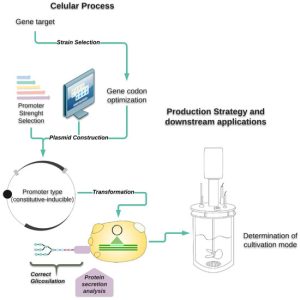
The most commonly used yeast species for recombinant protein production are:
- Saccharomyces cerevisiae
- Pichia pastoris (now classified as Komagataella species)
These organisms grow rapidly in inexpensive media and are relatively easy to genetically engineer. Compared with bacterial systems, yeast can perform several important protein processing steps, including:
- Disulfide bond formation
- Protein secretion
- Certain types of glycosylation
Historically, S. cerevisiae was the dominant yeast host used in industrial biotechnology. However, P. pastoris has gained significant popularity due to its ability to reach very high cell densities during fermentation, leading to improved protein yields.
One of the key features of P. pastoris expression systems is the AOX1 promoter, which is induced by methanol. This promoter allows tight regulation of gene expression and can drive extremely high levels of recombinant protein production.
Although yeast systems are efficient and scalable, their glycosylation patterns differ from those found in humans. Yeast proteins often contain hypermannosylated glycans, which may affect therapeutic performance or immunogenicity. Current research focuses on glycoengineering strategies to produce more human-like glycosylation patterns.
Mammalian Cell Expression Systems
For proteins that require complex folding and precise post-translational modifications, mammalian cell culture systems are often the preferred production platform.
Mammalian cells are capable of performing the full range of modifications found in human proteins, including:
- Complex glycosylation
- Phosphorylation
- Disulfide bond formation
- Proper folding of multi-subunit complexes
These properties make mammalian systems particularly important for producing therapeutic proteins, such as monoclonal antibodies and hormone therapies.
Two commonly used mammalian cell lines include:
CHO cells are widely used in the biopharmaceutical industry because they can produce high yields of therapeutic proteins and adapt well to large-scale bioreactor cultivation. HEK-293 cells are frequently used in research laboratories due to their high transfection efficiency and ability to produce proteins with human-like modifications.
Protein expression in mammalian cells can be achieved using either transient or stable transfection strategies. Transient expression allows rapid protein production within days, whereas stable cell lines require longer development times but provide consistent production over extended periods.
Despite their advantages, mammalian systems are associated with higher production costs, slower growth rates, and complex culture requirements.
Cell-Free Protein Expression Systems
Cell-free protein synthesis represents an alternative strategy that eliminates the need for living cells. Instead, protein production occurs in a biochemical reaction mixture containing the molecular components required for transcription and translation.
A typical cell-free system includes:
- Template DNA or RNA
- Ribosomes and translation factors
- Amino acids and nucleotides
- Energy regeneration systems
These components are usually derived from cellular extracts, such as E. coli, wheat germ, insect cells, or mammalian cells.
Cell-free systems offer several advantages. Because no living cells are present, researchers can manipulate the biochemical environment freely. This flexibility allows the incorporation of non-natural amino acids, cofactors, lipids, or detergents that would otherwise be toxic in living cells.
However, these systems typically produce lower protein yields and can be relatively expensive for large-scale manufacturing.
Recombinant Protein Production in Plant Systems
Plants represent an emerging platform for recombinant protein production. Species such as Nicotiana benthamiana, tobacco, maize, and rice have been used to produce recombinant proteins.
Plant-based systems offer several potential advantages:
- Low production cost
- High biomass yield
- Reduced risk of contamination with human pathogens
- Ability to perform complex post-translational modifications
Proteins can be expressed in plants through either stable genetic integration or transient expression methods. Transient expression is often preferred for rapid protein production, while stable transgenic plants are more suitable for long-term production.
One challenge associated with plant expression systems is that plant glycosylation patterns differ from human glycosylation. To address this issue, researchers are developing glycoengineered plants capable of producing human-compatible glycan structures.
Although plant biotechnology continues to advance, large-scale protein extraction and purification remain technically demanding.
 Insect Cell Expression Systems
Insect cells provide another eukaryotic platform capable of producing complex proteins. These systems are frequently used for structural biology studies, vaccine production, and protein engineering.
Common insect cell lines include:
- Sf9 cells
- Sf21 cells
- Hi-5 cells
- Drosophila S2 cells
Many insect cell expression systems rely on the baculovirus expression vector system (BEVS). In this method, the gene of interest is inserted into a baculovirus genome, which is then used to infect insect cells. The infected cells produce high levels of recombinant protein during viral replication.
Insect cells are capable of performing several post-translational modifications and often produce proteins that fold correctly and remain biologically active. However, their glycosylation patterns are simpler than those found in mammalian cells.
Transgenic Insect Platforms for Protein Production
Recent innovations have introduced alternative insect-based production strategies using transgenic organisms rather than cell culture systems.
One such approach involves genetically engineered Drosophila melanogaster strains capable of producing recombinant proteins within the organism itself. These systems take advantage of the extensive genetic knowledge and manipulation tools developed for fruit fly research.
Genetic expression in Drosophila can be controlled using systems such as GAL4/UAS, which allows precise spatial and temporal regulation of gene activity. Because Drosophila can perform complex post-translational modifications similar to mammalian cells, it provides an attractive host for producing challenging proteins.
Furthermore, large numbers of insects can be reared economically, offering potential advantages for scalable protein production without the need for large bioreactors.
Future Perspectives in Recombinant Protein Production
Recombinant protein technology continues to evolve as researchers develop new methods to overcome existing limitations. Each expression system offers distinct advantages, but none provides a universal solution for all protein types.
Microbial systems such as E. coli and yeast remain essential for producing simple proteins efficiently. Mammalian and insect cells enable the production of complex biologics requiring precise modifications. Meanwhile, plant-based platforms, cell-free systems, and transgenic organisms provide innovative alternatives for specialized applications.
The future of recombinant protein production will likely involve integrating multiple expression platforms, along with advances in genetic engineering, synthetic biology, and bioprocess optimization.
These innovations will expand our ability to produce complex proteins at scale, supporting the development of next-generation therapeutics, sustainable industrial enzymes, and advanced research tools.